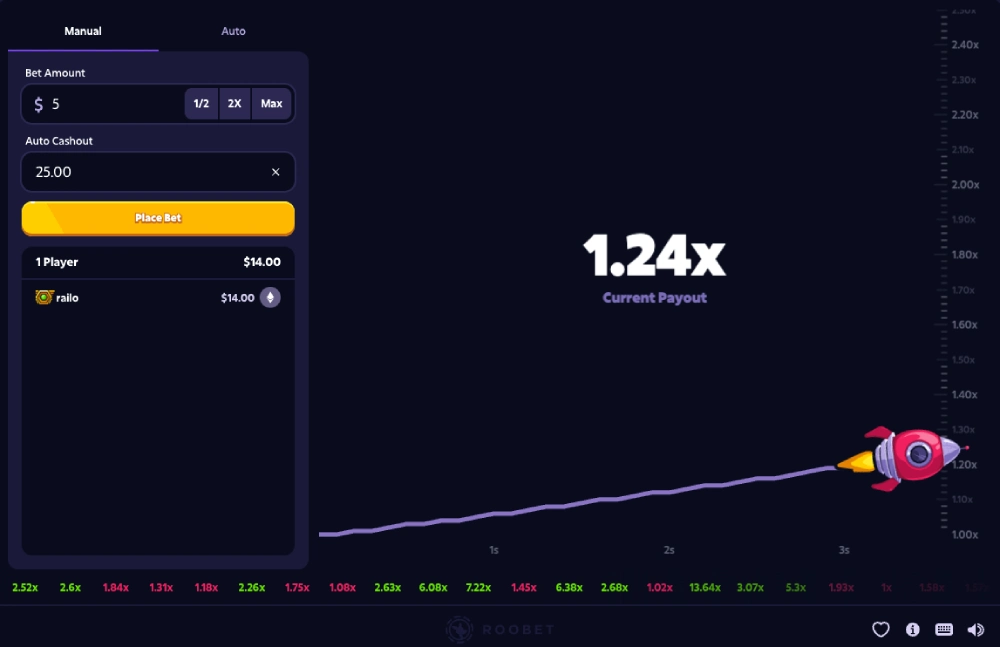


Ride the multiplier with the Roobet Casino Crash casino game guide
In the crash casino game, the multiplier starts at 1.00x and continues climbing until it reaches a random crash point. Your player wager remains active while the rising multiplier increases, making every cash-out decision a balance between securing a guaranteed payout or risking everything for a higher return. If the game crashes before you cash out, your round outcome is a complete loss.
Crash is a fast-paced game where every round is determined independently, creating an unpredictable experience that rewards timing over guesswork. Understanding how these mechanics work is just as important as knowing when to cash out. With this, this crash casino game guide will explain how provably fair verification allows players to confirm that every round outcome was generated fairly and could not be manipulated, while also exploring how crash gambling works at Roobet Casino before placing a wager.

What is a Crash casino game?
Crash is a game where a rising multiplier begins at 1.00x and continues increasing until it reaches a random crash point. The objective is to maximize the value of your player wager by making the right cash-out decision before the game crashes. If you wait too long and the multiplier crashes first, your wager is lost.
Crash is a round-based casino game that turns the payout into a live, real-time experience. Instead of waiting for a result behind the scenes, you watch the multiplier increase and decide the right moment to secure your winnings. The difference becomes clear as soon as you launch the game. Rather than spinning alone, you join a multiplayer interface, where every player follows the same multiplier progression in real time.
Every round puts you in control of your exit strategy. You can make a manual cash-out whenever you choose or set an automatic cash-out target before the round begins, allowing your winnings to be collected automatically if the chosen multiplier is reached.
While every crash game is built around this core mechanic, each title offers its own visual style, gameplay experience, and unique features. Here are some of Crash's standout characteristics:
- Visual styles - Some games feature a simple rising line graph, while others present flying spaceships, ascending planes, or characters dodging obstacles.
- Betting controls - Many interfaces allow you to place two separate bets on the same round with different exit goals with your real-time wagering.
- Game history - Most layouts display recent crash values at the top of the screen, so you can track recent round results.
- Custom limits - Options for minimum wagers, maximum payouts, and auto-play conditions differ from one game to another.
Despite all these visual differences, the core principle remains identical across this casino game category: balanced risk, simple choices, and instant results. This makes for a fun game you can always come back to.
How Crash gambling works
Crash’s system locks in the predefined round result before the betting period even ends. Understanding that the outcome is already set makes it much easier to see how payouts actually work in Crash. That rising curve on your screen might feel like it is calculating live, but the visual display is just for suspense.
To see how payouts work, it is important to look at two basic scenarios from the crash casino game guide. Here are those that use a simple $10 bet:
- Scenario A (Successful exit) - Place a $10 entry and set your goal to cash out at 2.00x. Crash reaches 2.5x before crashing, and because you exited at 2.00, your total return is $20 ($10 bet x 2.00). Subtracting your original $10 bet gives you a net profit of $10 after the wager settlement.
- Scenario B (Early Crash) - Make a $10 entry aiming for 2.00x, but the round crashes abruptly at 1.85x. Since the round termination happened before your cash-out went through, your $10 bet is lost, and your balance is updated immediately.
All the payouts and deductions update your casino balance as soon as the round ends. To get an even better perspective of Crash, it is also recommended to look into multiplier growth across the game.
Every Crash round moves through a strict timeline designed to keep gameplay fast and transparent. Here is a structure you can see for the Crash gameplay rounds:
- Countdown timer - A short bet placement window (usually five to 10 seconds) opens between rounds. You select your bet amount and adjust your settings.
- Round closure - Countdown hits zero, crash betting closes, and new entries are locked in for the next round.
- Multiplier progression - Crash rounds start at 1.00x and follow a steep multiplier curve.
- Crash event - The growth stops instantly at a preassigned value, marking the round’s end.
During Crash’s multiplier growth, you won’t get to enter. Automatic betting tools can be used to queue your wager for the next round. It is also vital to treat every turn as a set of independent rounds. Speed or visual flow of the curve never gives clues about how high the number will go. For instance, consider this sequence of three consecutive rounds.
- Round 1 - Crashes at 1.14x
- Round 2 - Crashes at 3.20x
- Round 3 - Crashes at 25.00x.
A low result in Round 1 does not force a high result in Round 2. Each result is generated separately, meaning previous values have zero mathematical influence on what happens next.
Determining when you cash out is when you make a decision during a round. Handling this choice through two primary methods matters, so get to learn more about them to improve the balance crediting.
- Manual exit - Monitor the rising line live and click or tap the cash-out button yourself.
- Automatic exit target - Type in a fixed exit number (such as 1.50x or 3.00x) before the round starts. Crash’s system automatically settles your turn the millisecond the game hits the mark.
The mathematical payout formula for any successful round is pretty simple:
- Total return = Stake amount x Exit multiplier
- Net profit = Total return - Stake amount
Here is a quick look at how different choices shape your bet settlement:
- Stake amount ($5.00) | Exit multiplier (1.30x) | Total return ($6.50) | Net profit ($1.50)
- Stake amount ($20.00) | Exit multiplier (1.05x) | Total return ($21.00) | Net profit ($1.00)
- Stake amount ($10.00) | Exit multiplier (5.00x) | Total return ($50.00) | Net profit ($1.50)
- Stake amount ($15.00) | Exit multiplier (Target: 2.00x) | Total return ($0.00) | Net profit (-$15.00)
With all the numbers you get, you have a classic risk-return trade-off. Selecting a lower automatic exit target leads to more frequent successful rounds, but each win yields a modest gain. Choosing a higher target offers a larger potential payout, but it increases the chance that the game crashes before reaching your target.
Understanding the numbers behind Roobet’s Crash helps set expectations for the game. Here are some of the factors behind the crash casino game that will play a role in your session:
Return-to-player and house edge
Return-to-player (RTP) rate is the theoretical percentage of all placed wagers that a game pays back over millions of automated turns. For example, a game with a 97% RTP has a built-in house edge of 3%.
Take note that RTP is a long-term statistical average across all players, not a guarantee for a short gaming session. Playing 10 rounds with a 97% RTP game does not mean you are guaranteed to recover exactly $97 from every $100 spent.
Volatility and expected value
Game volatility measures how spread out payouts are over time. Crash games are unique as their volatility changes based on your exit choices:
- Low volatility approach - Cashing out consistently between 1.10x and 1.30x creates smooth, low-variance session results with smaller individual returns.
- High volatility approach - Aiming for 10.00x or higher increases swing variance sharply, resulting in longer loss streaks offset by occasional large payouts.
The long-term expected value of every wager remains negative due to the small house edge built into the game’s probability distribution. Take note of these because, as you play, you can realize that it’s the long-term number you will get familiar with.
Provably fair verification
Modern crash games often use provably fair verification, so you can confirm that round outcomes are genuine and untouched. This system relies on simple cryptography with these factors:
- Server seed - The platform generates a hidden random string and displays its encrypted cryptographic hash before the round starts.
- Client seed - Your browser supplies a string of numbers, ensuring the platform cannot guess the combined input ahead of time.
- Nonce - A simple counter that increases by one with each round you play.
When your game round finishes, the unhashed server seed is revealed. You can paste these seed numbers into an open-source verification tool to confirm that the crash point was fixed before you placed your bet and was not altered during gameplay.