


Roobet Limbo: How the Roobet Originals Limbo game works
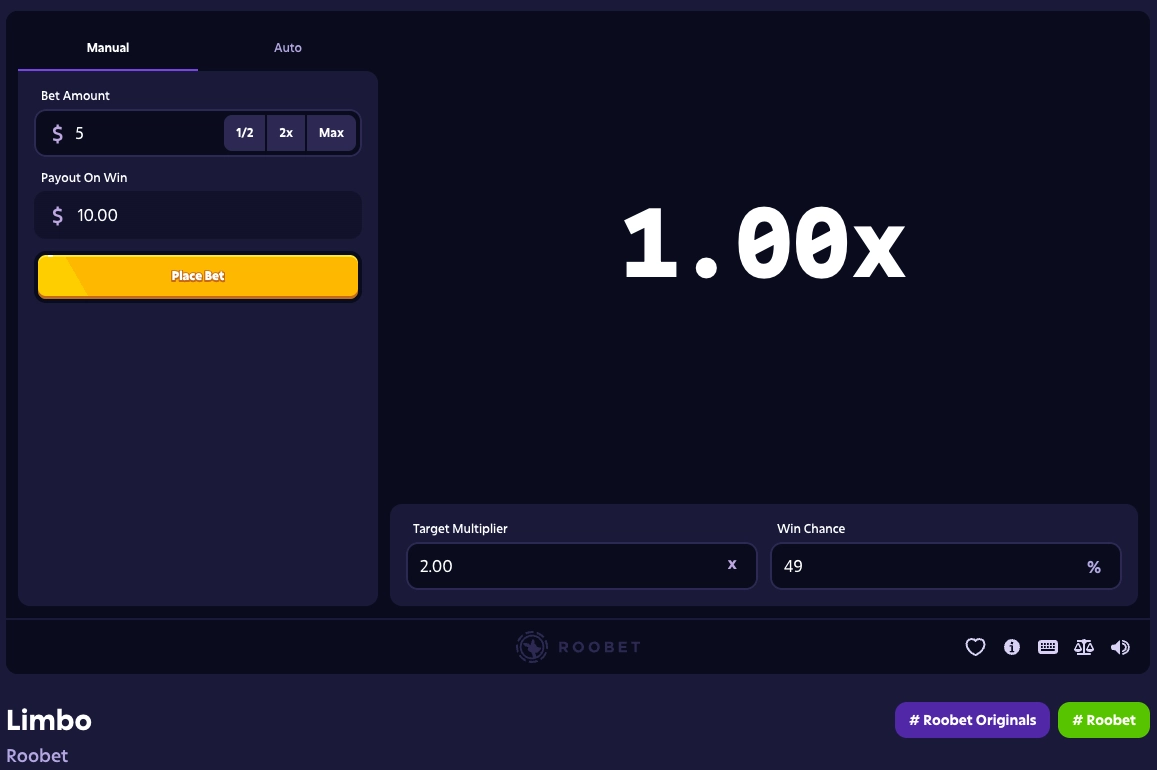
Roobet Limbo is a fast-paced multiplier game from Roobet Originals, the house-game collection at Roobet Casino. To play, you choose a target multiplier, place your bet, and win when the generated result reaches or exceeds that target.
Each round produces an instant game result, so there is no long wait between bets. Autobet is also available for automated rounds based on your chosen settings.
As a crypto casino game, Limbo combines simple multiplier gameplay with Roobet's provably fair gaming system. This guide explains how Limbo works, how its RTP and house edge affect play, how results can be verified, and what to know about strategies and crypto betting.
What is the Roobet Limbo game?
Limbo is one of the Roobet Originals games that you can play with a cryptocurrency or for free by setting the bet to under $0.01 to start the demo mode. Like other house games on the website, it is provably fair with verifiable seeds.
When you play the Limbo casino game, the random outcome of a bet is binary. You either lose your wager or win back your bet times the target multiplier. There is an instant-result game as soon as you place a bet, making it one of the fastest-paced casino games in Roobet.
Where Roobet Originals Limbo fits among Roobet house games
Roobet Originals Limbo falls under Roobet’s house-game category. These proprietary casino games are developed for the Roobet platform rather than being part of its third-party slot or live-dealer catalog.
Other Roobet house games include:
- Roobet Crash: Watch the multiplier rise and cash out before the round crashes.
- Roobet Mines: Pick safe tiles to build your payout, then cash out before hitting a mine.
- Roobet Dice: Set a target range and place a wager based on the outcome you want to hit.
- Roobet Keno: Select numbers before the game generates a random set and determines your payout from the matches.
- Roobet Towers: Choose tiles across successive rows while trying to avoid losing tiles and build your payout.
- Roobet Wheel: Spin the wheel and receive a payout based on the segment where it lands.
These games are built using the proprietary House Game APIs provided through Roobet Labs. The APIs give developers tools for creating different casino mechanics for Roobet, which helps explain the variety within its house-game category.
Limbo uses the same broader Roobet house-game infrastructure while having its own core mechanic. You set a target multiplier, place a wager, and receive a generated result. Its fairness system also allows eligible outcomes to be checked against the information used to generate them.


How the Roobet Limbo multiplier works
The Roobet Limbo game has a target multiplier that you set, and the generated multiplier is produced by random number generation (RNG). Your target works as a line that determines your win conditions. In Roobet Limbo, you win if the generated multiplier is higher than the target.
For example, you place a wager of $1, and the target multiplier threshold is 10x. You win this bet if the generated multiplier is 10.01x or higher, like 12x or more. Limbo then calculates your reward by multiplying your bet by the target. Hence, the multiplier payout is $1 x 10. The bet loses if the generated multiplier is 9.99x or lower.
Your probability of winning goes down the higher your target multiplier becomes. At 1.01x, you have a 97.5% chance of winning, and it drops to 49% at 2x. Higher-risk targets have a low chance of winning, but offer a big payout. Meanwhile, low-risk targets offer a more consistent hit rate.
Roobet Limbo RTP and house edge explained
Roobet lists Limbo with a 98% return to player (RTP), meaning that the game is designed to return 98% of wagers. Your actual results can be higher or lower than the RTP. A short session may include several wins, several losses, or a mix of both. RTP only describes the game's expected return over long-term wagering.
The house edge is the part that the game keeps over the long term. A 98% RTP means a 2% house edge. These figures describe the same game mathematics from two different sides: RTP shows the theoretical return, while house edge shows the theoretical amount retained.
Your target Roobet multiplier affects the risk and payout of each bet, but it does not change the game's listed RTP. A higher target has a larger potential payout but is harder to reach. A lower target is easier to reach but offers a smaller multiplier payout.
RTP is therefore a guide to long-term results, not a promise for any individual bet. The expected value only becomes meaningful across a large number of bets, so it cannot predict the result of your next Limbo round.
How to play Roobet Limbo
Playing Roobet Limbo only takes a few steps. You choose how much to wager, set a target value, and submit the bet. The game then generates a multiplier and immediately shows the bet result. Here’s the step-by-step process to follow when you play Roobet Limbo:
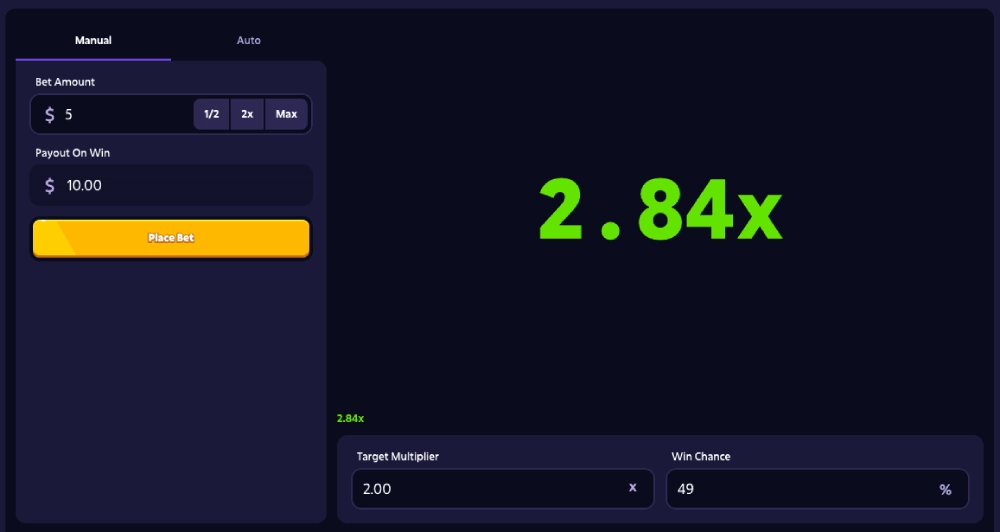
Choose your bet amount — Enter the amount you want to wager for the round. This is the money at risk if the generated result does not meet your target.
Set your target multiplier — Choose the target multiplier you want the generated result to reach. This target acts as the winning condition for the round.
Place the bet — Submit your wager to start the round. Manual betting lets you choose the bet amount and target multiplier for each round.
Check the generated result — Roobet Limbo generates a multiplier and displays the result immediately. If the generated multiplier reaches or exceeds your target, the bet wins. A result below your target means the wager loses.
Receive the payout — A winning bet returns a payout based on your wager and selected multiplier. For example, a $1 bet at a 5x target would produce a $5 total payout if the generated result reaches or exceeds 5x. This is an illustrative example of the payout calculation.
Roobet Limbo also offers autobet, which automatically places multiple wagers using the settings you choose. This means you can set up several rounds without submitting each bet manually.
The available controls include:
- Number of bets: This sets the total number of rounds Autobet will place before stopping.
- Stop on profit: Enter a profit target, and Autobet will end the sequence once that amount is reached.
- Stop on loss: A chosen loss limit tells Autobet when to stop placing further bets.
- On Win: Choose reset to return to the starting bet after a win. The increase by % option raises the next bet by the percentage you specify.
- On Loss: The same controls apply after a losing round. Reset returns to the starting bet, while increase by % raises the next wager according to your chosen percentage.
Autobet changes how wagers are placed, not how Limbo results are generated. Each round still produces its own random result, so these settings cannot predict or control the outcome of future bets.
Is Roobet Limbo provably fair?
Roobet Limbo uses a provably fair system that lets you check completed results against the cryptographic information used to generate them. An RNG uses game seeds and a fairness algorithm to produce each Limbo outcome, while cryptographic verification lets you check that the recorded result matches the original data. This provides a way to carry out bet verification rather than simply relying on the displayed result.
The key point is that provably fair describes how an outcome can be checked, not whether you will win. The system does not remove the house edge, prevent losing bets, or create a strategy that guarantees profit. Each round still relies on randomness, so checking a past result cannot predict what the RNG will produce in the next one.
How players can verify a Roobet Limbo result
You can check a completed Limbo result by reviewing the fairness data linked to the bet and reproducing the game's result. The process works as follows:
Find the completed Limbo bet: Start with the round you want to check in your bet history. You need the fairness data associated with that specific result.
Review the game seeds: The verification data includes a server seed and client seed. Roobet provides a SHA-256 hash of the server seed before the result, which allows the original seed to be checked later.
Check the nonce: The nonce works as a round counter. It changes between bets and forms part of the data used to generate each result.
Run the verification: Use the relevant Roobet provably fair verification tool with the recorded server seed, client seed, nonce, and other required information. The system applies the same fairness algorithm used to generate the original outcome.
Compare the results: The verification result should match the recorded Limbo outcome. A matching result shows that the disclosed inputs reproduce the original bet result.
The exact verification controls can vary between Roobet Originals, so check the current Limbo or Roobet Fair interface when verifying a result. The purpose remains the same: use the recorded cryptographic data to confirm that the outcome matches the original inputs.